Vitamin A Hypovitaminosis: A Case Report
Subjectives
Signalment: Two male Burmese mountain tortoises (Manouria emys), with an estimated age of 6 years old.
Chief complaint: bilateral apparent blindness that developed rapidly fast.
History: The Burmese mountain tortoises are raised in an open arena, measuring approximately 50 Sq. meter, at which they roam freely, while entering a heated shelter at dusk.
They are held with other tortoise species (African spurred tortoises, Centrochelys sulcata, Red–footed tortoises, Chelonoidis carbonaria and yellow–footed tortoises, Chelonoidis denticulata), and provided water ad lib.
Feeding occurs on a daily basis. Food includes mainly Romaine lettuce (Lactuca sativa L. var. longifolia) and black mulberry (Morus nigra) leaf, with a few other vegetable items such as commercially purchased tomatoes and cucumber. Every other week unprocessed industrial meat or dead rodents are provided to the tortoises to enrich their protein diet.
Medical History: The Burmese mountain tortoises did not have previous medical problems. They had good appetite and roamed their arena each day.
In April 2014 the owner have complained that both tortoises are apparently blind- their eyelids were completely closed and they lost their sense of orientation in the arena.
Medical assessment: Objectives–
Body weight- 1605g and 3300g for the bigger and smaller individuals, respectively, and total body length (straight measurement from the most distant parts of the carapace- 23cm and 29 cm, respectively.
Both the carapace and plastron were intact in both tortoises.
Locomotion- the tortoises moved freely at their arena with no hesitation or physical disability, although they were unable to use their visual cue for orientation. They were alert and responsive to tactile and noise stimulation.
Respiratory system- in both animals breathing was clear with no crackles or wheezes. No secretions have been observed from the nostrils or mouth.
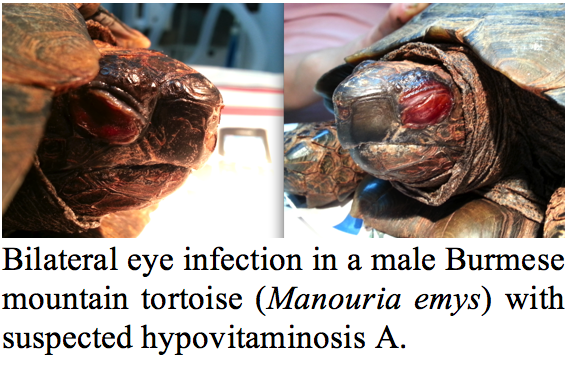
Visual system- in tortoises both eyelids were closed with the lower eyelid covered with a dry strong scale-like cover. In addition, the left eye of the bigger individual was swollen.
It was impossible to view and assess the cornea or conjunctiva.
Furthermore, an eye examination of the other tortoise species that are held together with the Burmese Mountain tortoises and fed similar food, did not indicate any eye problem.
Assessment–
Based on the fact that only the eyes the Burmese Mountain tortoises were damaged and following their nutritional and husbandry history, we believe that we deal with species-specific deficiency in one of the vitamins or minerals, probably Vitamin A hypovitaminosis.
Diagnostic plan and findings–
Eye smears were taken from both tortoises with sterile cotton swabs and placed on superfrost microscope slides. The smears were fixed in absolute methanol (5min) and stained by Dip Quick staining (Jorgensen Laboratories, Inc.). Since it was impossible to open the eyelids, the cotton swab were pressed at the eye slit and rubbed towards the medial puncta.
Blood was sampled by subcarapacial venipuncture and fixed and stained similarly to the eye smears.
The eye smears showed contamination that was dominated with Gram – bacteria. We could not exclude at least partial contamination of surrounding bacteria, but evidently most of the bacteria was sampled from the conjuctiva and medial puncta.
Blood from the smaller tortoise did not reveal systemic infection. However, blood of the bigger individual indicated a systemic infection of Gram – bacteria.
Treatment-
Husbandry and maintenance- Because of the lack of orientation the sick tortoises were held in a smaller 1.5 Sqm arena with shelter. Both tortoises had good appetite and they ate willingly food items that were directed to their mouth. Water was provided from a water container in which the tortoises were soaked daily.
Treatment was divided into three parts and was provided similarly to both tortoises- topical eye treatment, systemic treatment and changing the tortoise food and supplements to allow full cure and to prevent recurrence of the disease.
I. Eye treatment- On the first day of treatment we used first Benoxinate Hydrochloride 0.4% (Oxybuprocaine Hcl, Localin, Dr. Fisher, Israel) to alleviate pain and eye irritation.
The eyes were then cleaned at the following order three times a day: a few drops of sterile artificial tears, (V-Crima, Vitamed Ltd., Israel), followed by sterile ofloxacin 0.3% eye drops (Oflox, Allergan, Ireland). Ofloxacin solution was provided for two weeks. A 10-minutes period was allowed between each solution.
II. Systemic treatment- because of the systemic infection of Gram – bacteria, the tortoises were injected with amikacin antibiotics (injected IM to the foreleg) every 3 days for a period of two weeks.
III. Food supplements and feeding regime- initially, a special diet enriched with vitamin A was designed to the tortoises: it was based on cooked vegetables that contain high dosage of vitamin A such as cooked carrot. Because the tortoises were not able to visually forage for food, it was directed to their mouth for the first two weeks. In addition, three days after receiving the special diet the tortoises were injected with vitamin A (intracoelomic, at a dose of 100,000 IU/Kg).
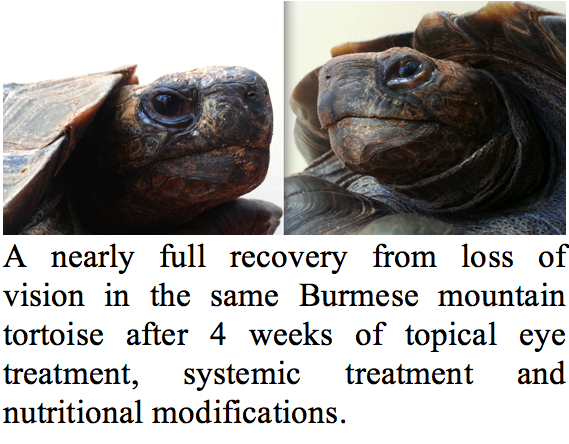
Results- the tortoises showed increased appetite every day but no apparent effect of treatment have been observed for at least two weeks. On the third week there was a minor improvement in the eyelid appearance: due to the intensive care the eyelids gradually opened and allowed better wash of the cornea and conjunctiva with the solutions applied. Thirty days after the start of the treatment the eyelids were fully open and the eyes were able to respond to visual cues. Eye treatment was ceased then but a special diet was recommended to the owner, in addition to a final examination to exclude ulcer.
Summary
Two Burmese Mountain tortoises were raised with other tortoise species in an open arena and provided with food dominated with Romaine lettuce and black mulberry leaf. Twice a month additional protein diet was added.
The Burmese Mountain tortoises were observed one day with permanent closed eyelids and were not able to roam their arena. A thorough examination revealed eye and systemic contamination with Gram – bacteria. Since the disease was restricted to the Burmese Mountain tortoises we suspected a secondary Gram – infection that followed poor body condition related to hypovitaminosis A.
The tortoises recovered their loss of vision and regained healthy condition after 4 weeks of persistent eye washes and topical plus systemic antibiotics. Also a vitamin A injection and food supplements contributed to their health.
 The International Center for Tortoise Conservation